 The weather is freakish, the climate is freakish and politics is, well, freakish. They have pushed me to where my head tells me the chance to pull ourselves out of the fire is about gone. But it is not as simple as slipping into despair and apathy, though that would be easier in some ways.
[This is an account of my personal journey regarding global warming. It expands on the recent post COP-out. I do not expect it to be published elsewhere.]
For a long time I have judged that there was some chance of averting the threatened climate apocalypse, even as I periodically grieved the lack of progress, or the chances missed along the way. A decade or two ago I thought the chances of averting disaster were perhaps 90%. That doesn’t sound too bad, but would you get on a plane with a 90% chance of arriving safely? Then the chances seemed about 50%, then 10%, 5%. One percent anyone? These numbers are highly subjective of course, but they represent my assessment of the evidence coming from climate scientists and the Earth itself.
First let’s look at weather and its consequences. The Black Summer, four years ago now, was beyond anything we had experienced since whitefellas arrived in Australia. It was the product of three years of severe drought and a fiercely hot and windy summer.
Then it rained, and in Lismore the flood was two metres above the previous record flood. Records are supposed to be broken by a little bit. If the water was two metres higher than the previous record, it would have spread much wider across the river valley and it would have been flowing faster. My guess is you need something like ten times the amount of water to raise the level by two metres. That is freakish.
A couple of years ago the temperature reached 49.7°C in a small town in British Columbia, Canada. Temperatures that high are supposed to happen in Saudi Arabia and the Pilbara, not in the cool temperate zone of the northern hemisphere. It was freakish. A few days later a fire destroyed much of the town.
In Spain a local record temperature was exceeded by 5°C. Not 0.5°C but five whole degrees. Other temperatures around the Mediterranean broke previous records by up to two degrees. Those are freakish conditions.
In the northern summer just past vast areas of Canadian forest burnt in wildfires. The forests were tinder dry from extended drought. It was their Black Summer. The smoke even blanketed New York city. Heaven forbid. Can the world be safe if the natural environment forces itself on the attentions of New Yorkers?
There are other examples, but the point is clear. The weather is doing things we have never known it do to. Reporters commonly don’t get it. They reflexively report record events: this was the hottest October the 21st in a leap year since records began, 0.2°C higher than the previous record. It’s not enough to say Lismore broke a record. Records are happening all the time.
The Lismore event was a freak. The weather is doing things beyond our previous experience. Something is seriously awry with the weather.
Then there are the big climate systems, like the oceans, the ice sheets and global average temperatures. I’ll put some pictures at the end of the text, so as not to bother those who prefer words, but I urge you to have a look. They are not hard to make sense of, and a picture can stay with you while words fade.
The North Atlantic sea surface temperature (Figure 1) has this past northern summer gone well outside the band of temperatures recorded over the past forty years. It has nearly doubled the previous excess over the mean. A glance at the red line in the graph shows you it has done something well outside its previous fluctuating behaviour. There is a steady trend to higher temperatures through the previous years, with lots of fluctuations, but this past year it has just taken off into unknown territory.
The extent of sea ice around Antarctica (Figure 2) this past year dropped dramatically below previous extents. 2016 and 2020 were on the low side, but still within or near previous extents. This year they have dropped away into unknown territory.
Figure 3 shows part of a plot of global average temperature. There has been a steady increase over a century or so – yes, that is global warming. 2021 and 2022 were on the high side, but still on the edge of previous years’ plots. 2023 has taken off into the wild blue yonder.
These graphs are scaring the climate scientists – and me. Big complex systems like the ocean-atmosphere system always fluctuate, and you can’t predict their behaviour in detail (weather can now be predicted a week or so ahead, but not months ahead). They have a habit of wobbling along more-or-less steadily for a time, but then they may suddenly shift into rather a different pattern. Before they shift their wobbles commonly get larger, until a wobble tips them over a limit and they slide off into another, rather different state. That shift is called a tipping point.
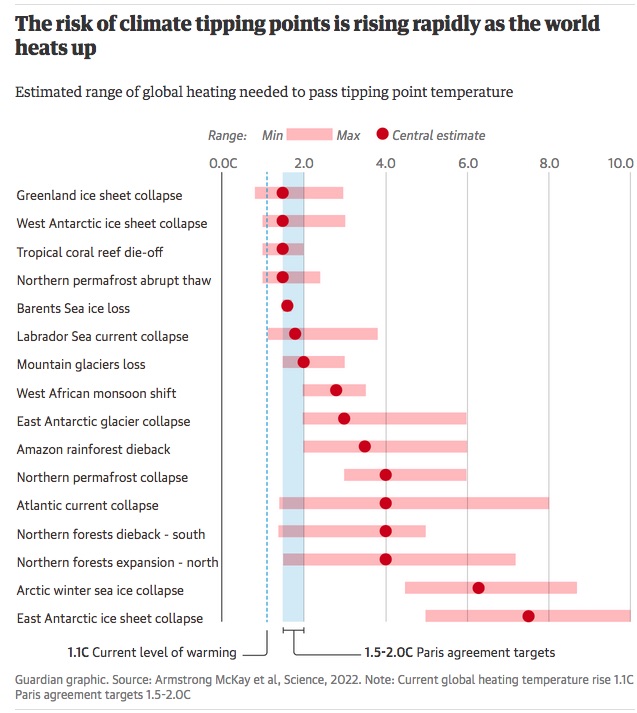
The graphs are scary because they suggest the climate system is about to shift (or is already shifting) into a rather different state. Tipping points are hard to predict, but climate scientists have identified a dozen or more parts of the global system whose tipping point can be estimated. Figure 4 is a graphical summary. About five of the systems could tip between 1.5°C and 2°C of warming, the target range of the so-called Paris agreement to reduce greenhouse gas emissions. At that time (2022) the warming was about 1.1°C, but this year it has shot up to around 1.4°C.
You will notice there is a pink band of uncertainty around each red dot. Perhaps those systems won’t tip until 2-3°C of warming. Or perhaps they are already tipping.
How do these changes affect us? Ice sheet collapses would be slow – taking decades or even centuries – but they would raise sea level by several metres. Many cities are built close to the sea, and close to sea level. Their harbours would be inundated. An abrupt thaw of the northern permafrost could release vast amounts of methane gas, which is a much more potent greenhouse gas. That could trigger runaway warming, passing other tipping points until warming reaches 4, 6, 8°C, we don’t know. The global environment would be drastically changed. Heat, drought, rain, monster storms all in the wrong places, monsoon failures. With such relatively abrupt change, most creatures, including humans, would have a hard time adapting and surviving, and many would not.
Now to politics. Our government is showing no signs at all of doing what the International Energy Agency urged around a year ago: do not approve any more fossil fuel extraction projects, remove all subsidies to fossil fuels, and phase down their use as rapidly as possible. They have approved quite a few new projects, subsidies now top $11 billion per year just in Australia, and extraction is set to double, though most of it will be exported, where it will make other countries too hot but not us. Right.
That last statement is bullshit of course. They don’t actually say that. Rather they say the emissions are then the responsibility of the country buying the stuff. They don’t mention how it keeps the addiction going. It is called the drug dealer’s excuse.
Although it once was the relatively enlightened and progressive party, federal Labor was recently thrown into panic when the High Court ruled it could not detain people indefinitely, and the Dutton-Murdoch axis leapt into action, scaring the punters with claims that all kinds of depravities would be visited on ‘the community’ because criminals were being released on Labor’s watch. Labor, true to recent form, had neither moral footing nor sensible policy position and simply went as low as the Opposition could sink them. This follows the loss of the referendum on a Voice for First Peoples, sunk by a highly organised and mendacious scare campaign.
This signifies that the depravity and insanity of the reactionary far-Right, after a set-back at the last federal election, is back in business, and also challenging Labor in the polls. They may or may not prevail, but they will delay the day when we might have a parliament that has some interest in doing something effective about the immense challenges we face.
Meanwhile the recent COP28 climate conference in Dubai was swarming with fossil fuel lobbyists, chaired by a major fossil fuel executive and produced nothing more than words. Those words left plenty of loopholes through which coal trains can be driven. They refused to say we should phase out fossil fuels. Instead they said we should transition away from them – but they claim gas is a ‘transition fuel’, so it’s business as usual.
These developments have forced me to the conclusion that virtually governments, including our own, are making little or no effort to avert global warming. Many of them are making it worse.
The climate scientists say we are on track to reach 3°C of warming by the end of the century. However that won’t happen because by then a whole series of tipping points will have been passed and we’ll be heading for perhaps twice that. We don’t know what the Earth will do, except it will be very unpleasant for us, or our children and grandchildren.
You wonder whether the politicians are just wilfully blind or if they are getting weird advice. Probably both. On the one hand you only have to watch the news (well, not Sky News) to get the idea we are way off track for having a safe planet to live on. So the politicians need to be wilfully blind and deaf to avoid that message.
But also, on the other hand, it turns out some famous economists have reassured the politicians that 3°C of warming will only lop a few percent off the GDP in 2100, but the GDP will be much bigger then anyway so it means we’ll be slightly less rich. Where does such utter nonsense come from? From the pseudo-Nobel prize winner William Nordhaus, who started his calculations by noting that about 90% of ‘economic activity’ is performed indoors or underground, so it won’t be affected by climate change!
It’s hard to know where to start, to counter such profound ignorance and wilful stupidity. A recent article called Nordhaus an idiot savant, a fair call. The whole mainstream economics profession is deeply ignorant of anything outside their mathematical manipulations, and they don’t understand how to do proper science either. But Nordhaus out-does them with such mega-stupidity, and on the mega-topic of wrecking the Earth.
So it seemed to me, recently, that my continuing intellectual hope, that governments could be persuaded/pushed/replaced in time to retain some chance of pulling back from catastrophe, has been in vain. I need to let go of that expectation. We are probably going into the fire.
Ah, but I wrote ‘probably’. Two things about that. First, we don’t know. There are many uncertainties. It is conceivable that enough will be done by, say, 2030 to keep the Earth from teetering over the edge. Uncertainties cut both ways. It may be too late already, or even 2030 may not be too late. No-one can prove either possibility. A sensible civilisation would opt for precaution, but we’re way past the point of precaution.
The other thing about ‘probably’ is that it leaves some room for the non-rational, non-intellectual parts of me. Simply, I would not stop trying to influence things for the better, for the sake of my grandchildren and yours, unless I was certain there was no hope. Perhaps not even then. Perhaps not even then because not much in life is that certain.
The other day I came across the following words.
‘It’s walking the razor’s edge of the sacred moment where you don’t know, you can’t count on, and comfort yourself with any sure hope. All you can know is your allegiance to life and your intention to serve it in this moment that we are given. In that sense, this radical uncertainty liberates your creativity and courage.’ – Joanna Macy
I recognised the first sentence, it is where I am now. I feel the second sentence, my allegiance to life. I wish I could believe, or feel, the last sentence about creativity and courage.
Who knows, perhaps someone will do/write/perform something so affecting and so profound it will turn a lot of hearts, and enough of us, around the planet, will decide to work together to do what needs to be done. If we pulled together, then I think we could pull it off. There is much we can do if we would just get on with it. But I don’t see it or sense it, just now.
I will not collapse into apathy or despair. I may grieve, as I have already before. I expect I will keep doing what I do, because how else can I look my children and grandchildren in the eye and because they deserve any chance we can give them.
But I will have this idea in my head, that I cannot offer you any reason to expect we will avoid the apocalypse. Without a rapid shift in politics, I can’t offer you any sure hope.
__________________________
Figure 1. North Atlantic sea surface temperature

Figure 2. Antarctic sea ice extent

Figure 3. Global average temperature
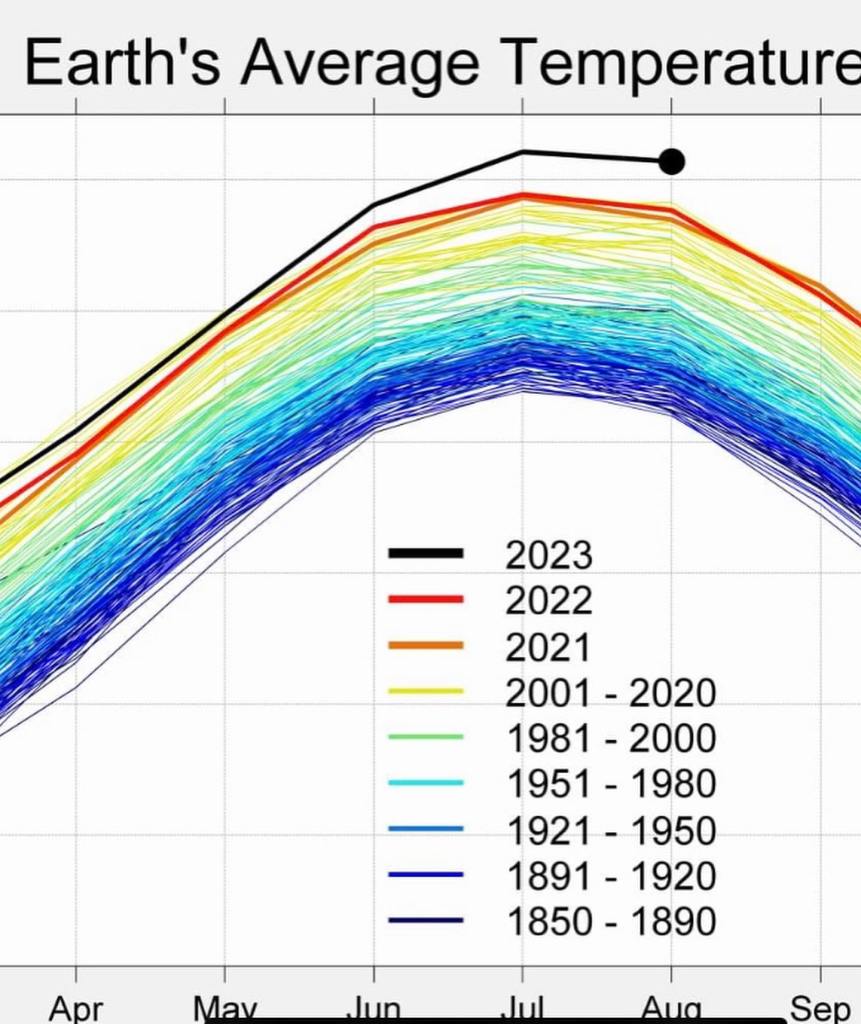
Figure 4. Tipping points.
 Thrival Economics