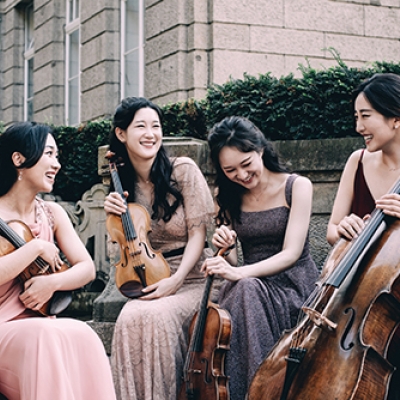
So I looked for a more recent performance and found the Esmé Quartet doing it on YouTube, from 2022. Never heard of them, but let’s hear what they’ve got, these four oriental women.
When I was discovering classical music at university long ago Schubert quickly became a favourite – the Unfinished Symphony, the Trout Quintet, the unearthly String Quintet, the widely-loved favourites of many besides me.
The Death and the Maiden string quartet (no. 14, D. 810, 1824) was soon among my favourites and has remained so. I came to regard it as having some of the most sustained passion of any work by anyone. Schubert’s health was poor (from syphilis it is widely inferred) and he was haunted by thoughts of death. From the harsh opening chord to the end it is a raw, agitated, troubled protest against his fate, so it seems.
Naturally I was interested to discover Schubert had written one more quartet, in 1826, before his untimely death in 1828, the Quartet no. 15 in G major D. 887. I have it on vinyl (it was the 1960s!) by the Vienna Konzerthaus Quartet. I suppose I couldn’t find a performance by the Amadeus Quartet, my favourites, who I have doing no. 14 and other works. So it is performed by four dour-looking men in dark suits. I found the music interesting but puzzling, and it didn’t grab me by the heartstrings the way so much of Schubert’s best music does. So it was a bit disappointing.
Recently I was reminded of the quartet, dug out the old vinyl and listened again, wondering if I would hear it differently now. Similar reaction: interesting, striking in some parts, but not quite up there. I always found the second movement a bit strange, a doleful tune that didn’t relate much to the Schubert I knew (versatile though he was). The cover notes quote someone saying the last movement is ‘a mad rondo, violent in rhythm and wild in harmony’. Really? I listened again and they plodded along. I realised it needed to be faster to rate as ‘a mad rondo’. If they picked up the pace that would give it more life.
So I looked for a more recent performance and found the Esmé Quartet doing it on YouTube, from 2022. Never heard of them, but let’s hear what they’ve got, these four oriental women.
They were a revelation. From the beginning there was more life in it. I could not define it, but clearly I was hearing a very different performance. In the second movement the cellist made that ‘doleful’ tune sing. The last movement was fast, and it is a mad rondo. Oh, now I begin to see why some people say this is Schubert’s greatest string quartet, even above DatM.
The music is said to be unusually demanding of performers. It is intense. All four instruments are going most of the time. Melodies are there, but it’s a lot about chords and progressions, fast progressions. Except in the ‘trio’ (middle) section of the third movement, which is a classically beautiful Schubert melody that he stretches and extends as only he could. There is lots of tremolo, there are dramatic figures and sudden dark-light shifts. I hear its sound relating to Death and the Maiden but now, rather than a wild (and radical) outburst this is more controlled, more purposeful, though just as intense and gripping.
It is astonishingly creative and powerful music. Of course one can’t imagine how the man distilled and condensed so much into the sounds of just four instruments. Nor how he keeps each instrument complementing the others all the time. Genius indeed.
And this group of women is a match for this music. They are intense (they have to be), but without strangling the music, keeping the lilt and life flowing through it. Watch them, on a screen big enough to see, and the music flows through their faces and their beings. There are rave comments on the YouTube page, so it’s not just me. I gather they have made a big splash internationally performing a wide range of music.
The ensemble takes its name from an Old French word meaning ‘loved‘ or ‘esteemed’. They are Korean, based in Germany (with the violist replaced more recently).
I usually don’t fuss much over which performance of a piece I like best, mostly they are all good. In this case the contrast in presentation, visual and musical, is dramatic. In place of the dour, dark-suited men are four women attractively presenting in feminine pastels. I gather some European institutions were decidedly sexist back in the day, so it is wonderful to see that old trope pushed aside so decisively. The music was conceived by an unusually sensitive and gifted man, and it is performed here by four unusually sensitive and gifted women.
This performance speaks to the universality of music and musical appreciation. More than that, it speaks to the universality of human experience and human capacities. These women, from so far geographically and culturally, do Schubert proud.
They also do a great job of Death and the Maiden. And if you’re inclined, do find a performance of the String Quintet. It is very different, with a second movement unlike anything else, elevating into some new realm. Here is someone talking about it, but it won’t mean much if you haven’t heard it. So skip the talk and listen, then maybe come back to the talk. (It comes in at no. 2 in the ABC Classic 100 chamber music, after his Trout piano quintet, a very accessible work. Well he took the top three spots, four of the top five and five of the top 10.)
One more thing. My acquaintance with classical music might have been much slower and more erratic if universities then were like they are today – digital learning opportunities with little or no hanging out with other students. Back then I lived on campus and encountered a group of classical musical fanatics who were delighted to introduce me to all they knew. My curiosity had been piqued by a family friend who was also passionate. I was ripe for their attentions. Yes I got degrees, but I also acquired lifelong passions for classical (and other) music and bushwalking.
 Thrival Economics