Submitted to Pearls & Irritations 26 Aug 2025.
Without civilisation, claimed Thomas Hobbes in 1651, life was, and would be, ‘solitary, poor, nasty, brutish and short’. Given how nasty and brutish much of our world is at present, and how many people’s lives are shortened by our brutishness, and how many people are extremely poor, one might wonder whether civilisation in any way moderates our bad behaviour, or even whether it exacerbates the problem. I argue that civilisation is most of the problem – we have yet to figure out how to live peaceably and constructively in large groups.
Julian Cribb worried recently that our vaunted clever brains are incapable of dealing with the implications of runaway technologies and, worse, they are being degraded by a flood of artificial chemicals. Both claims are very plausibly true. However I suggest there is a bigger factor of longer standing, as I’ll get to.
I argued over two decades ago that we needed not just to regulate the flood of artificial chemicals but to actually stop it at its source. Even if we tried to test all of the chemicals for harmful effects we could not, because we don’t know which harmful effects they might trigger in our highly complex bodies, and because harmful effects often show up only decades after exposure, or even in the next generation.
I have argued more recently that we have created a social-economic system, a global consumer-corporate machine, that self-propels without any person or people being in control and whose overall function is to turn more and more of the planet’s resources into stuff that we mostly don’t need and soon discard, creating more and more pollution. This machine is thus destroying our life support system.
To stop this machine we need to do three things. First, reclaim the commons from profit-seekers and return them to communities and governments. Second, radically reform and reduce the financial system so it facilitates useful and healthy enterprise rather than being a monster parasite sucking wealth out of our societies. Third, remove what Jason Hickel calls artificial scarcity, which keeps us running on the treadmill.
If we can stop the machine then we may stop the runaway technologies, the flood of chemicals and the broader destruction of our planetary life support system. These ideas are, of course, a little challenging politically and they have yet to echo around the chambers of government. Nevertheless we need to accurately diagnose the problems.
Yet even if we accomplished these reforms we would still have problems. Before the modern industrial era, written history was a parade of wars, invasions, tyrannies, oppression and general brutishness, with a sideshow of high architecture and art. There is still a fundamental problem to sort out.
The clearest insight into this problem in my view comes from Joshua Greene in his book Moral Tribes. He cites psychological research showing that we human beings are innately cooperative, but not all the time. We have a suite of innate behaviours that promote the cohesion of the group we live in, but those behaviours are only triggered if we can look others in the eye. To more remote people we are indifferent.
You can see how this suite of social responses would have served our ancestors when they lived in small groups or communities – as hunter-gatherers, herders or small-scale farmers. Wise cultures also attended to their relationships with outsiders. Australia’s First People had elaborate protocols for dealing with neighbouring groups, and inter-group conflict was contained.
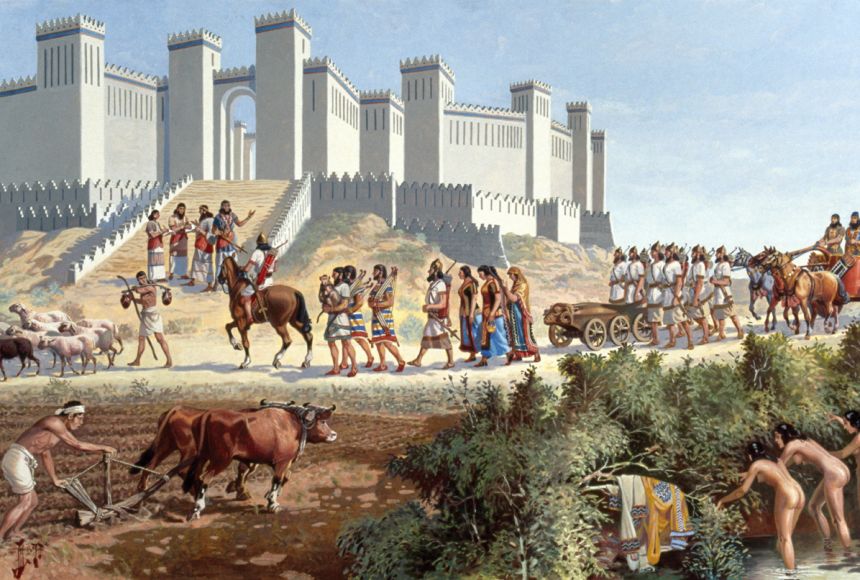
When people started living in larger groups the internal regulation through innate social responses was weakened. Even so, according to Graeber and Wengrow in The Dawn of Everything, early large settlements, of 10,000 people or more, lack evidence of a governing tyrant, implying they were run cooperatively, presumably with women being prominently involved. After about 5000 years ago ‘monarchy’ becomes clearly evident. From then on tyranny and oppression become the dominant pattern. Rulers, lacking social connection with the ruled, would easily turn to tyranny, and the ruled would be poor and suffer nastiness, brutality and short lives.
A further key insight comes from Robin Grille, in Parenting for a Peaceful World. He argues from abundant evidence that children raised in love become loving, and incapable of harming other people. People traumatised by neglect or violence on the other hand are easily triggered into lashing out, thus traumatising others. Thus trauma can be propagated through societies and down generations. So it seems the shift to living in large societies reduced social contact and empathy and opened the way for brutishness.
Now, a result of losing social connection in large societies is that we lose social and emotional sophistication. Rather than knowing the quirks and nuances of a close acquaintance and relating with them accordingly, we know only a few basics of a socially distant ‘leader’. We may then respond to crude signals, like promises to save us from troubles, or fears of outside invaders.
Thus the effect of living in very large groups has been to reduce our collective social sophistication and to distil ‘leaders’ who commonly operate at the crudest level of relationship, through empty promises, bribes, fear and violence.
Modern life might indeed be reducing our intelligence, but civilisation has for a long time stunted our collective emotional intelligence.
Daniel Quinn recognised this for a variety of other reasons and in 1999 published his subversive little book proposing that we move Beyond Civilization. Quinn suggested we learn to live in small groups, which he called tribes, whose members depend on each other to earn their living. He cites a newspaper office and a circus troupe as examples, and urges us to get creative.
Another suggestion is to adopt sociocracy, which is a self-governing system comprising ‘circles’ of a dozen or so people with whom we can maintain eye contact, each person contributing their first-hand knowledge and ideas on how to run an operation. For a large organisation there can be a hierarchy of circles, with each circle connected to ‘higher’ and ‘lower’ circles by a representative from each of those levels. In this way well-grounded information and ideas can travel both up and down an organisation, in contrast to our typical command hierarchies in which information and instructions travel mainly down, so the nominal leader is poorly informed.
Sociocracy was developed and refined within commercial firms, and it can work well. It is fair to call it a system of distributed leadership, a novel concept in our civilised culture.


Re: “The Dawn of Everything”
Unfortunately, that book lacks credibility and depth.
In fact “The Dawn of Everything” is a biased disingenuous account of human history (https://www.persuasion.community/p/a-flawed-history-of-humanity & https://offshootjournal.org/untenable-history/) that spreads fake hope (the authors of “The Dawn” claim human history has not “progressed” in stages, or linearly, and must not end in inequality and hierarchy as with our current system… so there’s hope for us now that it could get different/better again). As a result of this fake hope porn it has been widely praised. It conveniently serves the profoundly sick industrialized world of fakes and criminals. The book’s dishonest fake grandiose title shows already that this work is a FOR-PROFIT, instead a FOR-TRUTH, endeavour geared at the (ignorant gullible) masses.
Fact is human history since the dawn of agriculture has “progressed” in a linear stage (the “stuck” problem, see below), although not before that (https://www.focaalblog.com/2021/12/22/chris-knight-wrong-about-almost-everything ). This “progress” has been fundamentally destructive and is driven and dominated by “The 2 Married Pink Elephants In The Historical Room” (https://www.rolf-hefti.com/covid-19-coronavirus.html) which the fake hope-giving authors of “The Dawn” entirely ignore naturally (no one can write a legitimate human history without understanding and acknowledging the nature of humans). And these two married pink elephants are the reason why we’ve been “stuck” in a destructive hierarchy and unequal 2-class system , and will be far into the foreseeable future (the “stuck” question — “the real question should be ‘how did we get stuck?’ How did we end up in one single mode?” or “how we came to be trapped in such tight conceptual shackles” — [cited from their book] is the major question in “The Dawn” its authors never really answer, predictably).
Worse than that, the Dawn authors actually promote, push, propagandize, and rationalize in that book the unjust immoral exploitive criminal 2-class system that’s been predominant for millennia [https://nevermoremedia.substack.com/p/was-david-graeber-offered-a-deal]!
One of the “expert” authors, Graeber, has no real idea on what world we’ve been living in and about the nature of humans revealed by his last brief article on Covid where his ignorance shines bright already at the title of his article, “After the Pandemic, We Can’t Go Back to Sleep.” Apparently he doesn’t know that most people WANT to be asleep, and that they’ve been wanting that for thousands of years (and that’s not the only ignorant notion in that title) — see https://www.rolf-hefti.com/covid-19-coronavirus.html. Yet he (and his partner) is the sort of person who thinks he can teach you something authentically truthful about human history and whom you should be trusting along those terms. Ridiculous!
“The Dawn” is just another fantasy, or ideology, cloaked in a hue of cherry-picked “science,” served lucratively to the gullible ignorant public who craves myths and fairy tales.
“Far too many worry about possibilities more than understanding reality.” — E.J. Doyle, American songwriter & social critic, 2021
“The evil, fake book of anthropology, “The Dawn of Everything,” … just so happened to be the most marketed anthropology book ever. Hmmmmm.” — Unknown
LikeLike
Thank you Jon, I am quite capable of making my own judgements about the contents of ‘The Dawn’. Yes, the title is pretentious. Inside is a very wide range of material not previously easily available (not a monolithic ideology). They miss an obvious reason why early cities were taken over by tyrants – those cities were much richer prizes than just being chief of a few villages, so the barbarians invaded and made themselves pharaohs, as happened many times since. The common people suffered – and still do. I don’t see any basis for your vague claims of a pervasive ideology and I won’t be debating that here. I will leave your comment for now, despite its length but I won’t permit extended comments along these lines.
LikeLike