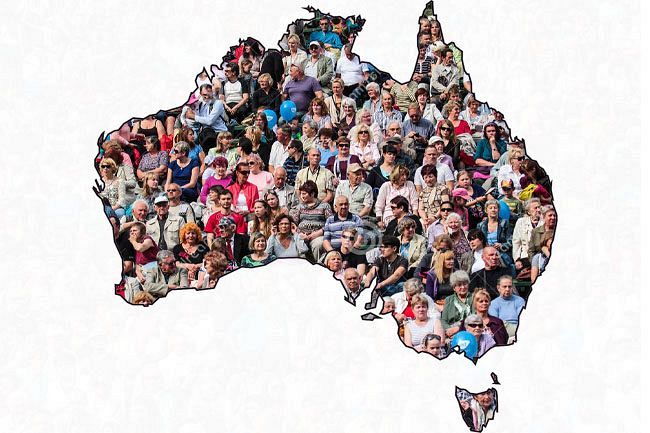
Discussion of Australia’s population, never notable for its rationality, has lately spun off into a neverland of slop, error, myth and delusion.
Discussion of Australia’s population, never notable for its rationality, has lately spun off into a neverland of slop, error, myth and delusion – quite apart from racism and xenophobia. We need to take a couple of steps back to regain a bit of perspective.
Many mainstream economists seem to be thrown into near panic by the prospect of a declining population, speaking of a demographic crisis or a demographic cliff. This is despite there being a number of countries whose economies are doing quite well as their population slowly declines.
It has become reflex among the political class to claim the economy will collapse without immigrants. It is asserted that the economy benefits hugely from immigration. Little evidence is offered for this claim, beyond an occasional mention that immigrants pay more taxes than they draw on welfare, so the federal budget benefits, as if that is a complete accounting of the economics of immigration.
Our aging population is claimed to be a huge challenge, and immigration is supposed to help to reduce the age profile. The claim by some industries of skills shortages has ballooned into a general cry that we lack all kinds of skills essential to a modern economy. At the same time we are supposed to be desperately short of unskilled labour for fruit picking and other menial tasks that will only be done by backpacker tourists.
House prices are asserted to be driven up by immigration, and also asserted to be unaffected, usually with little evidence offered for either claim. Some also blame overloaded infrastructure on immigration. There is some substance to these claims, but the cost of immigration is still commonly greatly underestimated.
So are we who already live in this modern, wealthy, well-resourced nation incapable of looking after ourselves? That is the implication of the claim that the economy depends on immigration. If we are indeed dependent on some imported skills, then that is a problem of our organisation. Specifically, our systems of education and training are not adequate to what we need. That is clearly true, as our Tafes and universities have been run down by successive governments intent on ill-conceived cost cutting. Privatised technical training commonly serves poorly, and our universities are in a dreadful mess thanks to being put in the hands of financial types who have no idea about education.
Demographers tell us that immigration only shifts the age profile very marginally. Neither are skills shortages resolved, partly because many skilled immigrants struggle to find matching employment. This points towards an obvious ulterior motive for the whole skills-shortage outcry, which is to keep downward pressure on wages, in other words to ensure cheap labour.
If our age profile does shift towards older people, are we saying we can’t afford to look after our oldies? Besides, if there are relatively more old people then there are relatively fewer kids, who are also expensive to care for and educate, so the net effect is marginal. People are living longer, but that doesn’t mean they are more dependent – typically the symptoms of aging don’t kick in until later, and the ‘burden’ of aged care is not greatly increased.
Population growth, whether from natural increase or immigration, imposes a substantial but little-recognised cost on the existing population. The reason is that each extra person requires extra ‘durable assets’. These include both public and private facilities, such as houses, schools, shops, roads, railways, water and electricity supplies and so on. So of course population growth increases demand for (private) housing and puts extra stress on (public) infrastructure. Dr. Jane O’Sullivan, in a pioneering study over a decade ago, estimated the extra cost to be about $500,000 per extra person. I have posted a more accessible summary here. The cost is presumably higher than this by now.
With population increase in the range of 300,000-400,000 per annum over recent years, this means we would have to pay around $150-200 billion per annum to maintain our standard of living. That is up to 10% of the GDP, a huge impost. Governments have been unwilling to fork out this much money, so our public infrastructure is overloaded. People can’t keep up either, so there is a housing shortage. We all pay the cost anyway, in diminished facilities.
It is claimed that the government only has control over part of our immigration intake. Really? That must also be a consequence of poor management. As a certain regressive prime minister asserted, ‘We will decide who comes to this country and the circumstances in which they come’. It was an ugly episode, but we do need to assert our control, though more humanely.
Mainstream economists seem only able to conceive of an economy that grows, but mainstream economics is based on a wildly unrealistic model of markets. Again, there is no reason a steady population cannot look after itself, if properly organised. Anyway the recent ‘growth’ of the economy has been due solely to population growth, and the GDP per person has been static or declining. So booming population growth does us no good and greatly increases the stresses on our natural environment.
There is a simple market solution to the challenge of picking fruit harvests. It is to offer higher pay. This would increase the cost of fruit, but if we also boosted the incomes of battlers they would still be able to afford good food, and market signals would be less distorted.
The solution to all these problems is to better structure and manage the economy. Importing more people at a frantic rate only exacerbates many problems, notably that of reducing our greenhouse gas emissions. This will require a government that keeps sight of some basic facts, and that has the nous and gumption to actually do its job.
Fixing the structural problems will take time, and in the meantime we could have some use for migrants, skilled or otherwise. So sudden drastic changes might well be disruptive.

