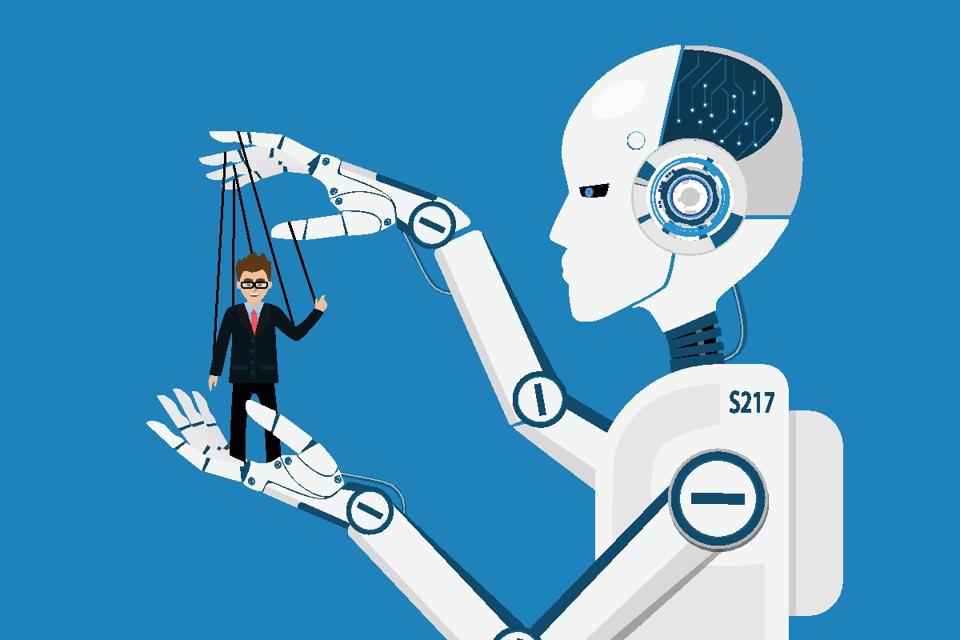
Long range weather forecasting, beyond a couple of weeks hence, is impossible because weather systems are technically chaotic: tiny changes now grow into system-wide changes within a few weeks. So-called artificial intelligence systems are unknowable if they are working as intended. Regulation of their behaviour will never be reliable.
Our culture is not used to dealing with physical systems that are complex or chaotic in a technical sense. The detailed behaviour of these systems is not predictable because the effect of a tiny change can grow exponentially until the details of the system are quite different from what they would have been without the tiny change.
A classic expression of this is the so-called butterfly effect. The effect of the flap of a butterfly’s wing in the Amazon forest could grow into an Atlantic hurricane three weeks later. Even if we had the computer power to follow minute details of Amazon weather, we can never have precise knowledge of the present state of the weather. Any tiny difference between our specification of the weather and the real weather system will eventually grow until our computer model is quite different in its details, and therefore useless for forecasting.
Such behaviour is called deterministic chaos: the weather system follows the known laws of physics exactly, yet its innately erratic behaviour is unpredictable in practice. Deterministic chaos was discovered in the process of trying to understand weather systems, and it has been found to occur in many other natural systems as well.
There are related systems that are not always chaotic, but they pass through transitions in which they are exquisitely sensitive to small influences, and we cannot predict which precise state they will emerge into. These are called complex systems, or complex self-organising systems, where the word ‘complex’ has this technical meaning, distinct from just being complicated.
It turns out that living systems are complex systems. You might take a young dog for a walk off-leash, but you can’t predict exactly what it will do in each next moment as it races back and forth and around you. On the other hand you can reasonably predict that it will be near you, and progressing generally in the same direction, however erratically. In the same sense, we can predict the average behaviour of a weather system even though the details are unpredictable. This is why climate modellers can model global warming even though they can’t predict next month’s weather.
I raise these examples of chaotic and complex systems to emphasise that we hubristic humans cannot control everything. That should already be obvious regarding people, whether in daily life or in the flow of history, but it doesn’t stop the ambitious or despotically-inclined among us from trying to control us, or pretending we are predictable.
Some economists like to believe the stock market is predictable. If it were, it would be far less volatile, as investors would all agree on the value of a stock and gaming the daily fluctuations would yield little profit. The financial markets, comprising human traders and human-created enterprises, are probably at least complex, if not chaotic.
And so to so-called artificial intelligence. Current models are certainly complicated, and their processing of information made available to them may be complex or chaotic, I don’t know. But the whole point of them is to do things we humans cannot do. If we could predict the answer an AI system would produce we would not need the AI system.
Certainly if they were to reach the stage of ‘recursive self-improvement’, where current generations of machines design and build the next generation, then we would not know what a machine was doing, let alone the truth of what it might deign to tell us.
There is currently a big discussion about the need to regulate AI to ensure it doesn’t do anything bad. There are technical people warning that AI could escape our control and even wipe us out. Even Chinese President Xi Jinping wants to regulate AI so it does not inadvertently disrupt China, or provide adversaries with the means to disrupt China.
There is a story that Elon Musk asked his AI box something, and it responded by praising Hitler. He spent his day trying to tweak it so it would not praise Hitler, but it turned out not to be straightforward to control the AI output. Of course it wasn’t.
There are calls for AI systems to have a ‘kill switch’, so they can be stopped if they are misbehaving. The computer Hal in the movie 2001: A Space Odyssey foretold this problem.
But even a kill switch would not be enough. One recent incident involved a swarm of ‘AI agents’ breaking into a company’s computers. What if a master AI machine created thousands of agents that lurked throughout the internet? How would we find them and turn all of them off?
It is naïve to imagine we can regulate AI systems.
This seems to lead inexorably to one conclusion that many people will hate: we have to stop developing AI. We have to dismantle the systems that exist.
In truth we don’t need AI. We have the means for every person on the planet to live well, and to do it in ways that keep the biosphere thriving around us. This has not happened because our political and economic systems are not designed to make it happen. It is our politics and economics that need some intelligence, not our machines.

