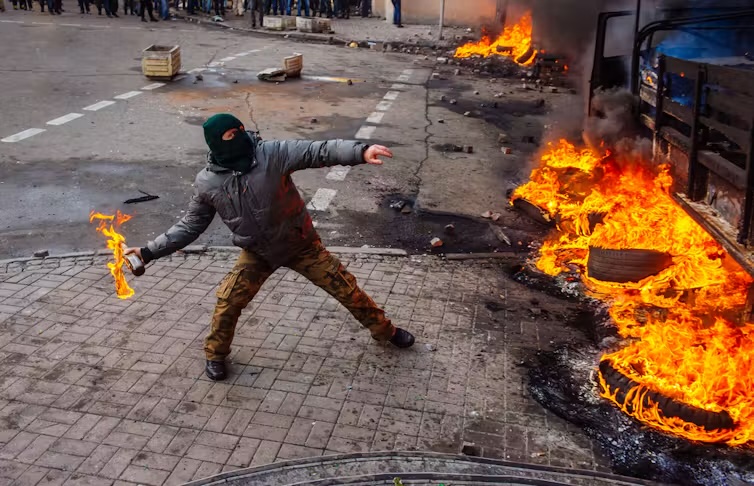
Some of the acrimony is specific to our modern societies, but some of it has very deep roots in our ‘civilised’ world.
[Sent to Pearls & Irritations, but they have been unreceptive to my stuff lately.]
There is a ‘civility pledge’ being promoted to our politicians: “In my political life, I pledge to act with honesty, respect and compassion.” It is a very worthy aspiration, and one that is a long way from the toxicity that is far too pervasive in our political culture. That pledge is part of a move to conduct politics more respectfully, in the wake of the recent shocking alleged attack on Independent MP Helen Haines.
If we want to reduce the level of acrimony in our politics we need to have some understanding of where it comes from. Some of it is specific to our modern societies, but some of it has very deep roots in our ‘civilised’ world.
Politics is about who wields power. For most of history, power has been wielded by strong men, who have competed for the top spot, and governance has been authoritarian. It is in the attempts to install more democratic systems over the past couple of centuries that the need for more civil political discourse has arisen. The media have been prominent promoters of incivility, aside from politicians themselves.
Media have always thrived on sensation. Some of the ‘quality’ newspapers toned it down, but there were always others that milked it. The Murdoch media have specialised in sensation for many decades. In recent times their business model has simplified to little more than cultivating outrage and partisanship.
There is a simple mechanism at work here: it is profitable for commercial media to promote outrage and division, so that is what we get. It is intrinsic to commercial media.
Social media have the same imperative as commercial legacy media, but the result is magnified because they select what you see. You can skim a newspaper and only read the bits you want. You can pay attention or not to a TV news item. But the algorithms severely limit the range of what is offered to you on social media. The result can be a spiral into a toxic little collection of misfits. And because there are millions, if not billions, of people connected, even the tiniest minority of weirdos can find each other and reinforce their weirdness. This much is commonly remarked upon: social media cultivate extremism as part of their business model, intentionally or not.
But there are also much older influences at work that involve our social nature. Human beings evolved living in small groups. We have many behavioural responses that serve to keep a group together and functioning, described by Joshua Greene in his book Moral Tribes. For much of the 300,000 years or so we modern humans have existed our survival depended on being part of a cohesive group. We might disagree and squabble, but the penalty for disrupting the group would have been swift, and commonly fatal.
About 6,000 years ago in the Middle East much larger settlements developed. The earliest did not have hierarchical structures, but after a millennium or so there is clear evidence of a king, courtiers, soldiers and commoners. It was not a good deal for most of the people: they worked harder, had poorer diets and suffered many new diseases, but that is not our focus here.
Our innate social responses work when we have direct contact, eye contact, with each other. In a group of a hundred or so you would know everyone. But in a group of 10,000 you would not. The king would have little contact with commoners, and his social responses would not be triggered. The behaviours that kept a small group cohesive and functioning do not work in large societies.
We live with the result. If the leader does something we don’t like, we grumble but have little power to change his mind. From feeling powerless comes anger, and then the other negative emotions. Not knowing a politician personally, it is easier to project a simplistic persona onto them. Without functioning behavioural constraints the negativity can feed on itself indefinitely.
Just because we do not have personal contact with a politician doesn’t mean we need to be nasty to them. We still have the choice to be respectful. Helen Haines and many others in public life attest to that. But we need to be aware of emotional impulses, like fear and anger, and to choose to override them.
Many people regard people as innately nasty, as spelt out by philosopher Thomas Hobbes centuries ago. But there is clear evidence against this. Rutger Bregman, in his book Humankind, debunks many of the stories commonly used to portray us as nasty. Robin Grille, in his book Parenting for a Peaceful World, argues from a lot of evidence that if we are raised in love we are incapable of murdering another person. This has manifested in many armies where it was found that soldiers were deliberately aiming their guns to miss because they could not bring themselves to shoot another person. Soldiers have to be trained out of this behaviour.
Grille argues that we can become violent if we have been traumatised. If we do not work to heal trauma then our violence can traumatise those around us, and trauma can propagate down the generations. The potential consequences of not healing trauma are being grotesquely demonstrated by Israel every day.
Traditional societies are not immune to violence, but large-scale organised violence – war – arose with the rise of hierarchical cities, unleashed by the failure of our innate behavioural constraints in large groups.
We can best contain violent language and violent attitudes if we recognise that we are innately highly social, and by addressing the traumas that underlie the violence that has become far too pervasive in our society. This is a big challenge, but it is our best chance to actually make a difference.

